
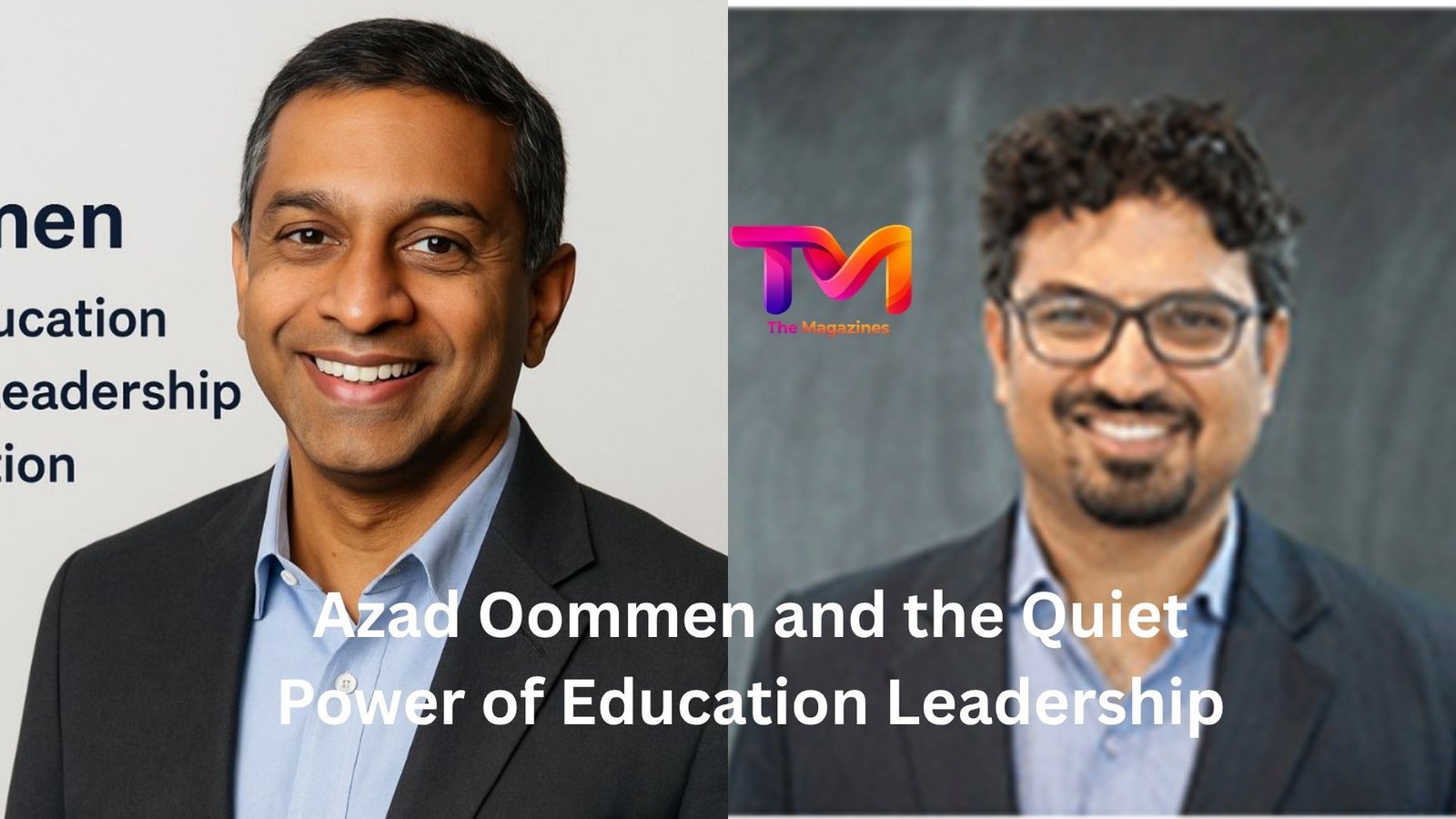
Most people can name famous tech founders or celebrity activists without thinking twice. But ask them about the people quietly shaping education systems across the world, and the room usually goes silent.
That’s where Azad Oommen stands out.
He isn’t the loudest public figure in education. He doesn’t chase headlines. Yet his work has influenced how schools are led in countries where millions of students still struggle with inconsistent learning systems, undertrained leadership, and limited resources.
And honestly, that’s part of what makes his story interesting.
A lot of education reform conversations get stuck in theory. Big speeches. Fancy reports. Endless panels. Oommen’s approach feels more grounded. More practical. He focuses on school leadership, which sounds simple until you realize how often that piece gets ignored.
A struggling school can have decent teachers, decent students, even decent funding, and still fail because nobody is steering the ship well.
That idea became central to his career.
Why Azad Oommen Focused on School Leaders Instead of Just Schools
One thing that comes up repeatedly in Oommen’s work is this belief that principals and school leaders shape almost everything around them. Culture. Teacher morale. Student expectations. Accountability.
Think about any workplace. A strong manager changes the entire atmosphere. A weak one drains energy from everyone around them. Schools work the same way.
Oommen co-founded Global School Leaders, a nonprofit focused on improving school leadership in underserved communities.
At first glance, it might sound niche. It’s not.
In many low- and middle-income countries, school principals are promoted without formal leadership training. Suddenly they’re expected to manage teachers, student outcomes, parents, budgets, and policy pressure all at once.
That’s a huge job.
Imagine being an excellent math teacher for ten years and then overnight becoming responsible for an entire school system without preparation. Most people would struggle.
Oommen saw that gap early.
Instead of creating another short-term charity model, he helped build systems that train leaders locally and sustainably. That distinction matters because education reform often collapses when outside organizations leave.
His model leans more toward building internal capacity than importing solutions from abroad.
That’s harder work. Slower too. But usually more durable.
The Career Path That Shaped His Thinking
Before launching Global School Leaders, Oommen worked in leadership development and philanthropy across several countries. He led programs connected to the , City Year in South Africa, and the Clinton Fellowship for Service in India.
That mix of experiences matters because education problems rarely exist in isolation.
Poverty affects learning.
Leadership affects poverty.
Policy affects leadership.
Community trust affects policy.
People working in development spaces eventually realize everything is connected. Oommen’s career reflects that understanding.
Later, he became the founding Executive Director of Central Square Foundation, an Indian philanthropy organization focused on improving school education.
That role pushed him deeper into systemic reform rather than one-off projects.
Here’s the thing. It’s relatively easy to improve one school with enough money and attention. Improving thousands of schools is a completely different challenge.
You need repeatable systems.
You need partnerships.
You need patience.
And probably a strong tolerance for bureaucracy.
Education Reform Sounds Noble Until You See How Messy It Really Is
People romanticize social impact work sometimes. The reality is far less cinematic.
A new leadership program might work brilliantly in one region and completely fail somewhere else. A strategy that improves attendance in Kenya may not translate to Brazil. Political priorities shift. Funding dries up. Governments change direction.
That’s partly why Oommen’s work has earned respect internationally. He doesn’t seem attached to flashy universal solutions.
His organization works with local partners instead of trying to dominate from the top down.
That approach feels more realistic.
If you’ve ever watched outsiders enter a community claiming they have all the answers, you know how quickly trust disappears. Good reform work usually starts with listening first.
Oommen has spoken and written about working “within systems” rather than against them.
That sounds boring compared to revolutionary slogans, but in practice it’s often what creates lasting change.
Schools don’t transform because somebody gives a motivational TED Talk. They improve through daily operational discipline. Better leadership meetings. Stronger teacher coaching. Smarter accountability. Clearer goals.
Not glamorous. Very important.
His Academic Background Helped, But It Wasn’t the Whole Story
Oommen studied International Economics at Georgetown University and later earned a Master’s degree in Public Affairs from Princeton University.
Those credentials obviously opened doors.
But education reform has a graveyard full of highly educated people with elegant ideas that never worked in reality.
What makes Oommen’s career more notable is the operational side. He didn’t stay trapped in policy theory. He moved into implementation, partnerships, training systems, and leadership development.
That combination is rarer than people think.
There are excellent thinkers who can’t execute.
There are excellent operators who struggle with long-term vision.
The people who can handle both tend to create wider impact.
The Global School Leaders Model Feels Timely
The timing of Oommen’s work matters too.
Over the last decade, conversations around education have shifted dramatically. Test scores alone no longer dominate discussions. People now talk more about resilience, emotional learning, school culture, leadership quality, and equity.
The pandemic accelerated that shift.
Some schools adapted quickly during crisis periods because leadership teams communicated well and stayed organized. Others collapsed under confusion.
That exposed how critical leadership really is.
Global School Leaders operates across multiple countries, including India, Kenya, Indonesia, Malaysia, and Brazil.
What’s interesting is that the organization doesn’t present school leadership as some elite executive skill reserved for wealthy private institutions. It treats leadership development as essential infrastructure for public education systems too.
That mindset changes the conversation.
A principal in a low-income district shouldn’t be expected to “figure it out” alone simply because resources are limited.
A Different Kind of Public Figure
A lot of people first hear about Azad Oommen because of his marriage to actress Poorna Jagannathan.
That’s understandable. Celebrity visibility naturally attracts attention.
But what’s refreshing is how separate their public identities remain. Oommen’s work isn’t built around fame or personality branding. He comes across more like someone deeply committed to a mission than someone cultivating a public image.
That’s increasingly uncommon.
Modern professional culture often rewards visibility over substance. Social media can make it feel like everyone is constantly performing expertise rather than quietly doing meaningful work.
Oommen’s profile feels almost old-school in comparison.
Low drama.
High impact.
Steady focus.
And honestly, there’s something appealing about that.
What Makes His Work Relevant Beyond Education
Even if you’re not particularly interested in schools or policy, there’s still something useful in Oommen’s approach.
He represents a broader idea that leadership development creates multiplier effects.
Train one capable school leader well, and they may influence hundreds of teachers and thousands of students over time.
That’s leverage.
The same principle applies in business, healthcare, nonprofits, and government. Strong institutions rarely happen by accident. They’re usually built by people who understand how leadership shapes systems from the inside.
Oommen also reflects a more thoughtful version of globalization.
Instead of exporting one rigid model everywhere, his work adapts leadership development to local realities. That balance between global knowledge and local context is difficult to get right.
Too much localization and systems become fragmented.
Too much standardization and programs lose cultural relevance.
The middle ground is where most meaningful work happens.
The Quiet Leaders Usually Matter More Than We Think
There’s a tendency to celebrate disruption in modern culture. Everyone wants the dramatic breakthrough story.
But many of the people creating long-term change operate differently.
They build institutions slowly.
They improve systems incrementally.
They stay focused for years.
That’s closer to Oommen’s style.
You probably won’t see him dominating viral headlines every week. Yet his influence spreads through schools, leadership programs, nonprofit partnerships, and education networks across multiple countries.
And maybe that’s the better model anyway.
Because real educational change usually looks less like a cinematic revolution and more like a principal learning how to support teachers effectively. A school culture improving over time. Students gradually receiving a more stable learning environment.
Small shifts repeated consistently.
Those changes don’t always attract public attention, but they shape lives quietly in the background.
That’s the kind of impact Azad Oommen seems most interested in creating.














Leave a Reply