
Most people don’t think about the exact moment their brain recognizes a face, reads a word, or identifies a coffee mug sitting on the table. It feels automatic. Effortless. You glance, and you know.
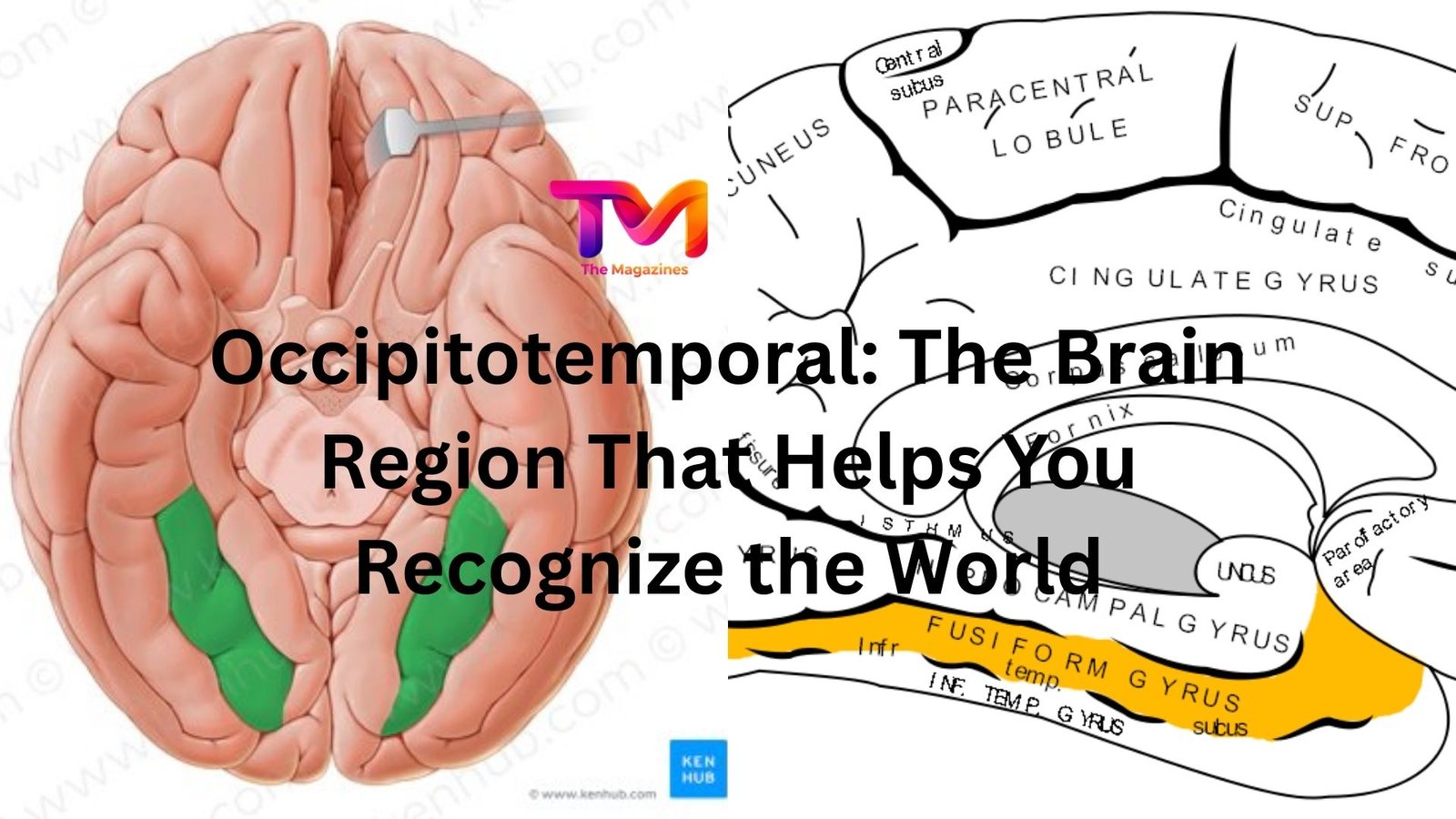
Behind that tiny moment of recognition sits a fascinating part of the brain called the occipitotemporal region.
It’s not a word you’ll hear in everyday conversation. But this region quietly does some of the most important visual work your brain performs. It’s where raw visual information begins turning into meaningful objects, faces, and written language.
If the visual cortex is the camera, the occipitotemporal region is where the brain starts saying, “Ah, I know what that is.”
Let’s unpack what this region does and why it matters more than people realize.
Where the Occipitotemporal Region Lives
The name sounds complicated, but it’s actually just geography.
The occipitotemporal region sits where two major parts of the brain meet:
- the occipital lobe, which processes visual information
- the temporal lobe, which deals with recognition, memory, and meaning
Picture the back and underside of the brain. That’s roughly where this area lives.
When you open your eyes and look around, the occipital lobe first handles the basic visual data: edges, contrast, color, movement. Think of it as raw image processing.
But raw images aren’t very useful on their own. You need to recognize things.
That’s where the occipitotemporal area steps in. It helps transform visual signals into recognizable objects, faces, animals, tools, and words.
In simple terms, it’s where seeing turns into knowing.
The Brain’s Object Recognition Engine
Here’s a small everyday moment.
You walk into your kitchen half awake. On the counter is a strange silhouette. Your brain quickly decides: that’s a toaster.
You didn’t analyze it consciously. You didn’t compare measurements or calculate shapes.
Recognition just happened.
The occipitotemporal region is heavily involved in that process.
Scientists sometimes describe it as part of the brain’s ventral visual pathway, often nicknamed the “what pathway.”
The job of this pathway is straightforward: figure out what you’re looking at.
When visual information travels from the occipital lobe toward the temporal lobe, the occipitotemporal cortex becomes a crucial stop along the route. Here the brain begins assembling features into recognizable categories.
Edges become shapes.
Shapes become objects.
Objects become meaning.
A curved handle and cylindrical body suddenly equal “mug.”
Four legs and a backrest equal “chair.”
And it happens in a fraction of a second.
The Famous Face Area
One of the most interesting parts within the occipitotemporal region is something called the fusiform face area.
This area has one main specialty: recognizing faces.
Humans are incredibly good at identifying faces. We can recognize people in poor lighting, from odd angles, even after years without seeing them. That ability relies heavily on structures within the occipitotemporal cortex.
When the fusiform face area is working normally, recognizing someone feels effortless.
But when it’s damaged, something strange can happen.
A person may develop prosopagnosia, often called face blindness. They can still see eyes, noses, and mouths. Vision itself is fine. Yet the brain fails to combine those features into a recognizable identity.
Someone with prosopagnosia might walk right past a close friend or fail to recognize a family member unless they hear their voice.
It’s a striking reminder that recognition is not the same as vision.
The Brain’s Reading Center
Another remarkable function of the occipitotemporal region involves reading.
There’s a specialized area often called the visual word form area. It sits in the left occipitotemporal cortex and becomes highly tuned to written language.
When you see a word, your brain doesn’t decode each letter slowly like a child learning the alphabet. Instead, experienced readers process word shapes almost instantly.
The occipitotemporal cortex helps make that speed possible.
Here’s a quick test.
Look at this word:
restaurant
You didn’t read it letter by letter. Your brain recognized the whole pattern almost instantly.
That recognition pathway develops with reading experience. Children learning to read gradually build stronger connections in this region. Over time, the brain starts recognizing word forms as familiar visual patterns.
Without that system, reading would feel painfully slow.
Why the Brain Organizes Recognition This Way
At first glance, it might seem odd that the brain dedicates specific areas to recognizing faces, words, and objects.
But there’s a reason.
Recognition is computationally heavy. The brain receives massive amounts of visual information every second. If every image required full analysis from scratch, we’d move through life at a snail’s pace.
Instead, the brain builds specialized recognition shortcuts.
Think of it like a library with sections. Rather than searching every shelf for every book, you go directly to the category you need.
The occipitotemporal cortex acts as one of those organized sections. Different clusters of neurons become tuned to certain categories:
- faces
- animals
- tools
- places
- written words
That organization allows the brain to process complex scenes extremely quickly.
Which is good, because the world moves fast.
When the System Breaks Down
Damage to the occipitotemporal region can lead to unusual perceptual problems.
One well-known condition is visual agnosia.
People with visual agnosia can see objects clearly but struggle to recognize them. Imagine looking at a bicycle and not knowing what it is until you touch it or hear someone describe it.
Vision works. The eyes send the information. But recognition fails.
Different types of recognition deficits can occur depending on which part of the occipitotemporal cortex is affected.
Some individuals lose the ability to recognize faces.
Others struggle with objects.
A few lose the ability to read words fluently.
These cases have helped neuroscientists map the brain’s recognition systems in surprising detail.
Sometimes, understanding what breaks tells us more than observing what works.
How Experience Shapes This Region
One fascinating detail about the occipitotemporal cortex is how experience changes it.
Your brain doesn’t start life with a fully specialized recognition system. It develops through exposure and learning.
Take reading again.
No one is born with a built-in reading circuit. Written language is far too recent in human history for evolution to design a specific brain module.
Instead, the brain repurposes existing visual recognition circuits. With enough practice, parts of the occipitotemporal region become tuned to letter patterns and words.
A similar thing happens with expertise.
Bird watchers, for example, often develop stronger recognition responses for bird species. Car enthusiasts may quickly identify car models others can’t distinguish.
The brain adapts. Recognition becomes sharper with practice.
Why This Region Is So Efficient
Speed matters in perception.
Imagine crossing a busy street while your brain slowly analyzed every object in your field of vision. Not ideal.
The occipitotemporal pathway allows recognition to happen in fractions of a second.
Researchers using brain imaging have found that object recognition signals can appear within 150 to 200 milliseconds after seeing something.
That’s faster than conscious thought.
Your brain is already identifying objects before you even realize you’ve seen them.
Which explains those moments when you instinctively react before fully understanding why.
Your recognition system fired first.
The Occipitotemporal Region in Everyday Life
Most of the time, this brain region works so smoothly that we forget it exists.
But it’s active constantly.
Reading street signs.
Recognizing a friend across the room.
Identifying fruit in a grocery store.
Spotting your car in a crowded parking lot.
Even small tasks rely on it.
You glance at your phone and instantly recognize app icons. That recognition happens through visual feature processing in areas linked to the occipitotemporal cortex.
The modern world might actually be pushing this region harder than ever before. Logos, symbols, icons, emojis, and rapid visual information all demand quick pattern recognition.
And the brain handles it surprisingly well.
What Makes This Region So Fascinating
Neuroscience often reveals that the brain is less like a single computer and more like a network of specialists.
The occipitotemporal cortex is a perfect example of that principle.
It sits at a crossroads between seeing and understanding. Without it, the world would still be visible but strangely unfamiliar.
Shapes would exist. Colors would appear. Movement would still be detectable.
But recognition—the feeling of “I know what that is”—would struggle to happen.
That simple moment of recognition we experience hundreds of times a day depends on millions of neurons quietly doing their work in this tucked-away region of the brain.
The Quiet Translator of Vision
The occipitotemporal region doesn’t get the attention that areas like the frontal cortex receive. It doesn’t control decision-making or personality.
Yet it performs a task that’s just as essential.
It translates vision into meaning.
Every time you recognize a loved one’s face, read a word on a page, or identify an object in a split second, this part of your brain is doing its job.













Leave a Reply