
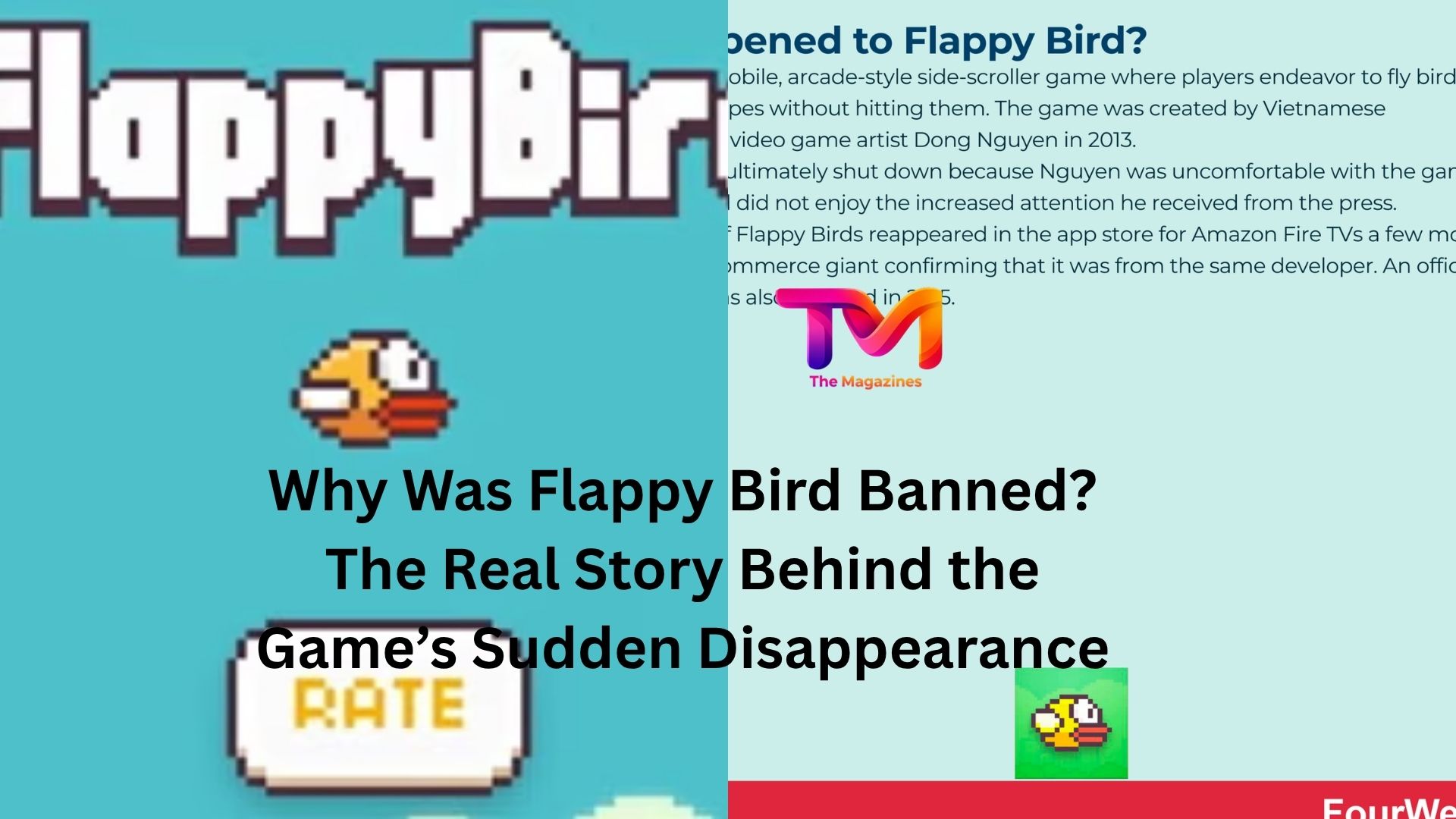
For a few months in 2013 and early 2014, it felt like everyone was playing Flappy Bird.
You’d see people hunched over their phones on buses, in waiting rooms, during lunch breaks, and sometimes even at work when they should’ve been doing something else. The game looked almost laughably simple. Tap the screen to keep a tiny bird flying. Avoid the pipes. That’s it.
Yet somehow, millions of people couldn’t stop playing.
Then, right when Flappy Bird was at the peak of its popularity, it vanished.
The game disappeared from app stores overnight, leaving players confused and sparking countless rumors. Some people believed it was banned by Apple. Others thought Nintendo had taken legal action because the game’s pipes looked similar to those in Super Mario. A few even assumed governments had stepped in because the game was so addictive.
Years later, many people still ask the same question: why was Flappy Bird banned?
The short answer is that it wasn’t actually banned. The reality is much stranger and much more human.
Flappy Bird Was Removed, Not Banned
Let’s clear up the biggest misconception first.
Flappy Bird was never officially banned by Apple or Google. Neither company forced the game off their platforms.
Instead, the creator of Flappy Bird, a Vietnamese developer named Dong Nguyen, chose to remove it himself.
That decision shocked the gaming world.
At the time, Flappy Bird had become one of the most downloaded mobile games on the planet. Reports suggested it was generating tens of thousands of dollars per day through advertising revenue. Most developers dream about reaching that level of success.
Nguyen did the opposite. He walked away from it.
Imagine opening a small coffee shop and waking up one morning to find a line stretching around the block. Business is booming. Money is pouring in. Then a few weeks later, you lock the doors and leave.
That’s roughly how surprising the situation felt.
The Overnight Success Nobody Expected
Part of the mystery comes from how unexpected Flappy Bird’s rise really was.
The game launched in 2013 with very little attention. For months, it sat quietly among thousands of other mobile games.
Then something changed.
Players started sharing their high scores online. Videos appeared on YouTube. Social media users challenged friends to beat impossible-looking scores. The game’s difficulty became part of its appeal.
Scoring five points felt like an achievement.
Scoring twenty felt impressive.
Scoring fifty made you look like some kind of gaming wizard.
The frustration kept people coming back. Every failure felt close enough to success that another attempt seemed worthwhile.
Many players experienced the same cycle.
“Just one more try.”
Then ten minutes passed.
Then thirty.
Then an hour.
The Pressure Became Too Much
As Flappy Bird exploded in popularity, Dong Nguyen’s life changed dramatically.
Before the game’s success, he was a relatively unknown independent developer. Suddenly, journalists wanted interviews. Millions of players were discussing his game. News outlets around the world were publishing stories about him.
For some people, that level of attention might feel exciting.
For others, it’s overwhelming.
Nguyen later explained that the game’s popularity had become a serious burden. He wasn’t comfortable with the spotlight. More importantly, he became concerned about the effect the game was having on players.
One of his most widely quoted comments was that Flappy Bird had become “an addictive product.”
That statement fueled endless debate.
Was he being serious?
Was he simply exhausted?
Was there another reason hiding behind the scenes?
Only Nguyen knows exactly what he was feeling, but his public comments consistently pointed toward personal discomfort rather than legal pressure.
The Addiction Concern
Here’s the thing: Flappy Bird wasn’t complicated.
There were no giant worlds to explore.
No deep stories.
No character customization.
No multiplayer features.
Yet players kept returning.
The game relied on a simple reward loop. Every failure happened quickly. Every success felt earned. The controls were easy to understand but difficult to master.
That’s a powerful combination.
Nguyen eventually said he felt uncomfortable with how much time people were spending on the game. He reportedly wanted to create a fun distraction, not something that dominated players’ attention.
Whether people agree with his decision or not, it’s a rare example of a developer stepping back from enormous financial success because of personal concerns.
In an industry often focused on maximizing engagement, that choice stood out.
Did Nintendo Force Flappy Bird Off the Market?
One rumor refused to die.
Many people believed Nintendo threatened legal action.
The theory wasn’t completely random. Flappy Bird featured green pipes that looked similar to the pipes seen in Mario games. The visual resemblance was obvious enough that players frequently mentioned it.
Soon rumors spread that Nintendo lawyers had stepped in.
The story sounded believable.
A massive gaming company versus an independent developer.
Classic internet drama.
The problem is that there was no evidence supporting it.
Nintendo publicly denied forcing the game’s removal. The company stated it had not taken action against Flappy Bird.
That didn’t stop the rumor from spreading, but it significantly weakened the claim.
While the game certainly borrowed visual inspiration from classic gaming aesthetics, there is no confirmed indication that legal pressure from Nintendo caused its disappearance.
Were Apple or Google Going to Remove It?
Another theory suggested Apple or Google planned to take the game down.
Again, there’s little evidence supporting that idea.
Both companies had approved the game for their stores. It remained available until Nguyen voluntarily removed it.
If either platform had forced its removal, there would likely have been official statements or policy explanations.
None appeared.
Instead, Nguyen announced the removal himself through social media and followed through shortly afterward.
The decision came directly from the creator.
That’s one reason the story remains so unusual. Most famous app removals involve policy violations, copyright disputes, security concerns, or legal conflicts.
Flappy Bird didn’t follow that pattern.
The Internet Didn’t Believe the Explanation
Many people struggled to accept Nguyen’s reasoning.
Let’s be honest. Walking away from a game earning massive daily revenue sounds irrational to most people.
As a result, alternative explanations flooded online discussions.
Some claimed there was a secret lawsuit.
Others believed government regulators had intervened.
A few conspiracy theories suggested hidden agreements with larger gaming companies.
None of these stories were supported by credible evidence.
Yet they persisted because the official explanation seemed difficult for people to understand.
Financial success is usually viewed as the ultimate goal. When someone voluntarily gives it up, observers often assume there must be another motive.
Sometimes, though, the simple explanation is the correct one.
A developer became uncomfortable with the consequences of his creation and chose to remove it.
What Happened After Flappy Bird Disappeared?
The removal created an unexpected secondary craze.
Phones with Flappy Bird installed suddenly became valuable.
People began listing old smartphones online for astonishing prices, claiming the devices contained the now-unavailable game.
Most of those listings didn’t result in serious sales, but they generated plenty of headlines.
Meanwhile, countless copycat games appeared.
Developers rushed to create similar experiences featuring flying animals, obstacles, and nearly identical gameplay mechanics.
For a while, app stores were flooded with Flappy Bird clones.
Some attracted attention.
None captured the same cultural moment.
Part of Flappy Bird’s appeal came from timing. It arrived at exactly the right moment when mobile gaming, social sharing, and viral internet culture collided.
That’s difficult to replicate.
The Legacy of Flappy Bird
More than a decade later, people still remember Flappy Bird.
That’s remarkable when you consider how simple the game was.
Thousands of mobile games launch every year. Most disappear without leaving much of a mark.
Flappy Bird became part of internet history.
Its story is taught in discussions about viral products, mobile gaming trends, and the unpredictable nature of online popularity.
The game’s removal also highlighted something people often forget.
Success can create problems.
From the outside, fame and money seem universally desirable. In reality, they bring pressure, expectations, scrutiny, and stress.
For Dong Nguyen, those trade-offs apparently outweighed the benefits.
Whether people agree with his decision isn’t really the point.
The decision was his to make.
Why People Still Search for the Answer
The question “Why was Flappy Bird banned?” continues appearing because the story feels incomplete.
We’re used to dramatic endings involving lawsuits, scandals, or corporate battles.
Instead, Flappy Bird’s disappearance came from a personal choice.
That explanation lacks the excitement of a conspiracy theory, but it’s supported by the evidence available.
The game wasn’t banned by Apple.
It wasn’t removed by Google.
Nintendo didn’t force it off app stores.
The creator himself pulled the plug.
That’s what makes the story memorable. One of the most successful mobile games of its era didn’t disappear because it failed. It disappeared because the person who made it decided success had become more trouble than it was worth.
And in a world where everyone seems to be chasing bigger numbers, that’s still a pretty unusual ending.







Leave a Reply