
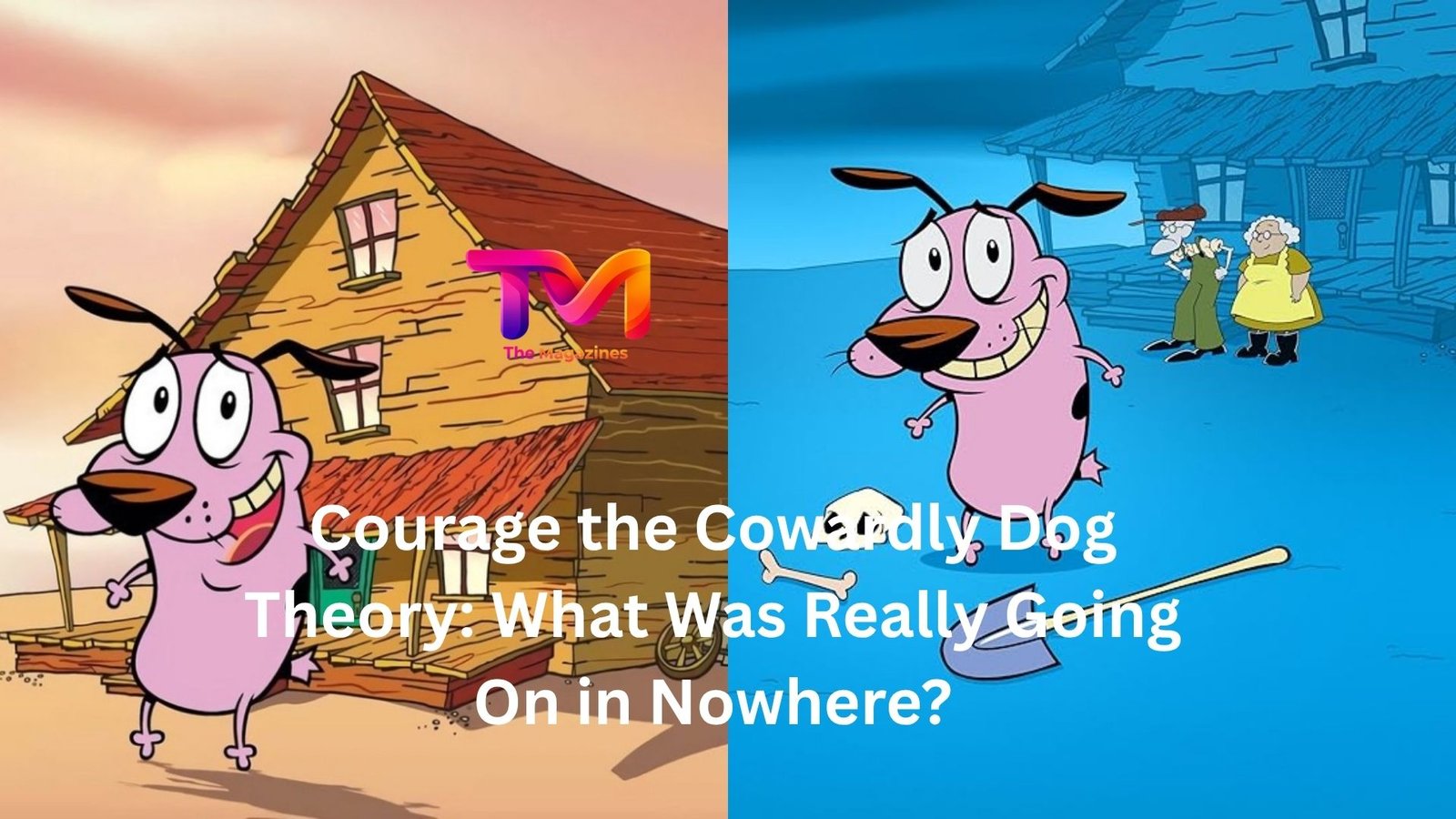
There’s something off about Courage the Cowardly Dog. You feel it almost immediately. The empty landscape. The strange visitors. The way danger shows up like clockwork and disappears just as quickly. As a kid, it was creepy in a fun way. As an adult, it starts to feel… deliberate.
That’s where the Courage the Cowardly Dog theory comes in.
Fans have been picking apart the show for years, trying to explain why everything in Nowhere feels so surreal. Some theories are wild. Others are surprisingly grounded. But a few stick because they actually make the show make more sense.
Let’s get into the one that refuses to go away.
The “Everything Is Normal, Courage Just Thinks It Isn’t” Theory
At the heart of it, this theory is simple: nothing in the show is actually supernatural. Or at least, not in the way we see it.
Everything is filtered through Courage.
Think about it. He’s a small, anxious dog living in the middle of nowhere with two elderly humans. He doesn’t understand the world the way people do. So when something unfamiliar shows up, his brain fills in the gaps.
A traveling salesman? To Courage, he’s a shapeshifting monster.
A doctor with odd tools? Clearly a mad scientist.
A rude neighbor? Probably some kind of villain.
It’s not that these things are harmless. Some of them are genuinely dangerous. But the idea is that Courage exaggerates everything because he’s scared of everything.
Honestly, that tracks.
If you’ve ever had a dog lose its mind over a vacuum cleaner, you’ve seen a version of this. To us, it’s a household appliance. To them, it’s a roaring, unpredictable beast that invades their space.
Now imagine that level of fear applied to everything.
Why Muriel and Eustace Never Seem to Notice
Here’s where the theory gets stronger.
Muriel and Eustace almost never react to the horror the way Courage does. Muriel stays calm, kind, and oddly unfazed. Eustace is grumpy but rarely terrified in the same way Courage is.
If these threats were as extreme as they appear, you’d expect more panic.
Instead, Muriel treats most situations like mild inconveniences. Someone breaks into the house? She offers them tea. A bizarre character shows up uninvited? She’s polite, even welcoming.
That disconnect starts to make sense if you assume we’re seeing Courage’s version of events.
Muriel might just be interacting with eccentric people. Courage sees monsters.
Eustace, being who he is, probably assumes everything is either annoying or beneath his concern. That’s why he doesn’t react much either.
It’s like three people watching the same situation through completely different lenses.
The Isolation of Nowhere, Kansas
Let’s talk about the setting for a second.
Nowhere isn’t just a quirky name. It’s basically accurate. There’s nothing around for miles. No neighbors (at least none we consistently see). No real community. Just a farmhouse sitting in the middle of an empty landscape.
That kind of isolation does something to perception.
Spend enough time alone, and small things feel bigger. Strange things feel stranger. Your mind fills in silence with noise.
For Courage, that isolation could amplify everything he experiences. There’s no “normal” to compare it to. Every new person or situation feels like a massive disruption.
And if you’ve ever stayed somewhere remote—like a cabin in the woods—you know how quickly your imagination can turn on you. A branch scraping a window suddenly sounds like someone trying to get in.
Now imagine living like that full-time.
The Repetition of Danger
Another detail fans point to is how frequently danger appears.
It’s constant.
Almost every episode introduces a new threat, a new character, a new crisis. And yet, life resets by the next episode.
That’s not just cartoon logic—it actually fits the theory.
If these events are exaggerated or misinterpreted, then the “reset” makes sense. Nothing truly catastrophic happened. Courage simply perceived it that way in the moment.
Think about how memory works when you’re anxious. A stressful event can feel huge while it’s happening, but later, it shrinks. Or you reinterpret it.
Courage might be doing that in real time. Each episode becomes a heightened version of something more ordinary.
Courage as an Unreliable Narrator
Here’s where things get interesting.
If we accept this theory, then Courage becomes an unreliable narrator. Not in a deceptive way—he’s not lying—but in a perceptual one.
We’re seeing the world as he experiences it, not as it objectively is.
That changes how you watch the show.
Suddenly, the horror elements feel less literal and more psychological. The villains become symbols of fear rather than concrete threats. Even the animation style—those warped faces, distorted movements—starts to look like visualized anxiety.
It’s like watching someone’s inner world projected onto reality.
And honestly, that makes the show even more impressive.
But Some Things Don’t Fit So Neatly
Now, let’s be fair. This theory doesn’t explain everything.
There are moments where the show leans very hard into the supernatural. Characters transform in ways that seem too extreme to be simple misinterpretation. Some episodes involve events that affect the environment in lasting, visible ways.
And occasionally, Muriel or Eustace do react to something unusual—just not as dramatically as Courage.
So it’s not a perfect explanation.
You could argue that the truth sits somewhere in the middle. Maybe some threats are real, while others are exaggerated. Maybe Courage is right more often than the theory gives him credit for.
Or maybe the show intentionally blurs that line.
Why This Theory Sticks With People
Here’s the thing: people like explanations that make weird stories feel grounded.
The Courage the Cowardly Dog theory does exactly that.
It takes a chaotic, eerie cartoon and reframes it as something more relatable. Fear. Anxiety. Misinterpretation. The idea that the world can feel overwhelming when you don’t fully understand it.
That hits differently as an adult.
You start to see Courage less as a “coward” and more as someone doing their best in a world that feels unpredictable and threatening. He’s scared, sure—but he still acts. He still protects Muriel. He still faces whatever comes his way.
That’s not cowardice. That’s resilience.
A Different Way to Watch the Show
Try this sometime.
Pick a random episode and watch it with this theory in mind. Don’t focus on the monsters. Focus on what they could represent.
A pushy stranger. A confusing situation. A moment of danger that feels bigger than it is.
Watch how Courage reacts, then imagine how the same situation might look from Muriel’s perspective.
It turns the show into something almost introspective.
You’re not just watching a horror-comedy cartoon anymore. You’re watching a character navigate fear in the only way he knows how.
The Real Takeaway
Whether the theory is “true” doesn’t really matter.
What matters is what it reveals about the show—and about how we interpret things when we’re afraid.
Fear distorts. It magnifies. It fills in blanks with worst-case scenarios. Courage just happens to live in a world where that distortion is visible.
And yet, despite all of it, he keeps going.
He’s scared every single time. No growth montage. No sudden bravery switch. Just fear—and action anyway.
That’s probably why the show sticks with people.
Not because of the monsters.
But because, in a weird way, it understands what it feels like to be overwhelmed… and to keep moving anyway.














Leave a Reply