
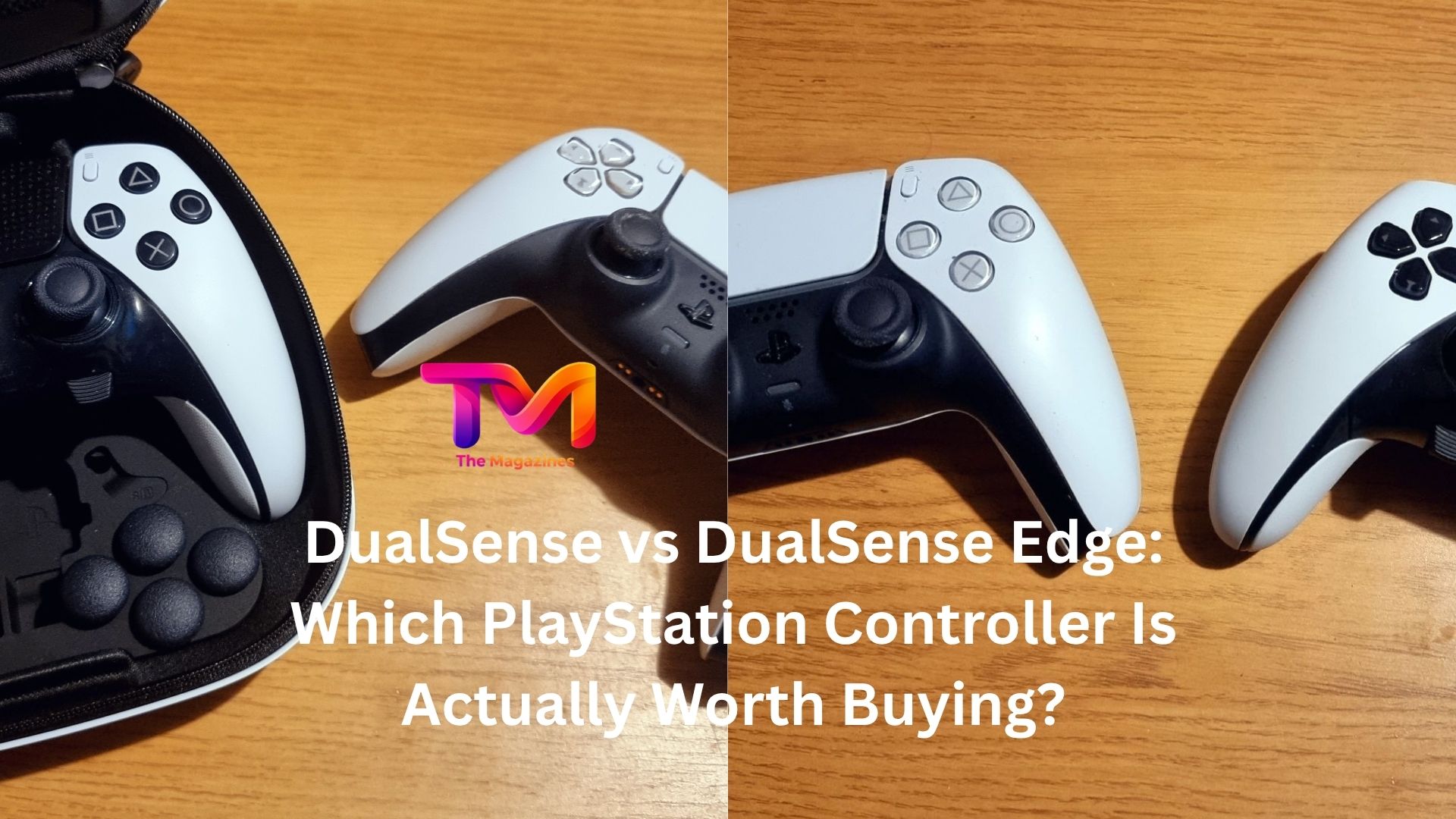
The PlayStation 5 launched with one of the best stock controllers Sony has ever made. The DualSense changed expectations with adaptive triggers, detailed haptic feedback, and a more comfortable design than previous PlayStation controllers.
Then Sony released the DualSense Edge, a premium version aimed at players who want more control, customization, and competitive features.
At first glance, the two controllers look almost identical. Put them side by side and most people wouldn’t immediately notice the differences. The real question isn’t whether the DualSense Edge is better. It is. The question is whether it’s better enough to justify spending significantly more money.
The answer depends entirely on how you play.
The Core Experience Is Surprisingly Similar
Here’s the thing. Both controllers deliver the same fundamental PS5 experience.
You still get the excellent haptic feedback that makes games like Spider-Man 2 and Astro Bot feel more immersive. You still get adaptive triggers that add resistance when drawing a bow or pulling a trigger in a shooter. The shape, button layout, and overall feel remain familiar.
If someone handed you either controller while playing a single-player game for an hour, there’s a good chance you wouldn’t immediately feel a dramatic difference.
That’s important because many buyers assume the Edge somehow transforms every game. It doesn’t.
The standard DualSense is already a very good controller. In fact, it’s arguably one of the strongest pack-in controllers ever included with a console.
The Edge starts making sense when you want more than the basics.
Where the DualSense Edge Pulls Ahead
The biggest advantage of the DualSense Edge is customization.
Sony designed it for players who like tweaking controls and optimizing performance. You can remap buttons, adjust trigger sensitivity, create custom profiles, and switch between setups without digging through game menus.
Imagine you’re playing Call of Duty one night and Gran Turismo the next.
With a standard DualSense, you’re stuck with whatever settings each game provides. With the Edge, you can create controller profiles specifically tailored for each game and swap between them quickly.
That flexibility becomes surprisingly useful once you get used to it.
The controller also includes back buttons, which many competitive players consider essential.
Instead of taking your thumb off the right stick to press face buttons, you can assign certain actions to the rear paddles. That means you can jump, crouch, reload, or perform other actions while keeping your aim steady.
For casual players, this may sound like a small thing.
For someone who spends hours in multiplayer shooters, it can feel like a meaningful upgrade.
The Back Buttons Matter More Than You Think
One of the easiest ways to understand the Edge’s appeal is to picture a common gaming situation.
You’re in a fast-paced shooter. An opponent appears unexpectedly. You need to jump, aim, and shoot almost simultaneously.
With a standard controller, your thumb briefly leaves the stick to hit a face button.
With rear paddles assigned to jump, your thumb never moves.
The difference lasts only a fraction of a second, but competitive games often come down to tiny advantages.
That’s why professional players and serious enthusiasts often gravitate toward controllers with rear buttons.
Even outside shooters, back buttons can improve comfort. Some players assign sprinting, weapon switching, or other frequent actions to the rear paddles simply because it feels more natural.
Once you build the habit, going back can feel surprisingly awkward.
Swappable Stick Modules Add Practical Value
Stick drift remains one of the most frustrating controller problems in modern gaming.
Anyone who’s experienced a character slowly walking across the screen without touching the stick knows exactly how annoying it can be.
Sony addressed this issue in an interesting way with the DualSense Edge.
The thumbstick modules can be replaced.
Instead of replacing the entire controller when drift becomes severe, you can swap the affected module. It’s a smart idea that potentially extends the controller’s lifespan.
Now, this isn’t a magical solution. Replacement modules still cost money, and availability can sometimes be inconsistent.
Even so, the option provides peace of mind that the standard DualSense simply doesn’t offer.
For players who log hundreds or even thousands of hours, that feature alone may carry real value.
Battery Life Is One Area Where the Standard DualSense Wins
Let’s be honest.
For all its premium features, the DualSense Edge takes a noticeable step backward in battery life.
The standard DualSense isn’t exactly famous for marathon battery performance, but it generally lasts longer than the Edge.
Many users report needing to recharge the Edge more frequently, especially during extended gaming sessions.
That’s partly because of the extra hardware and features packed inside.
If you mostly play near a charging cable, this probably won’t matter much.
If you regularly spend entire weekends gaming from the couch and hate interruptions, it’s worth considering.
Battery life isn’t exciting to talk about, but it’s one of those details that becomes very important after the honeymoon period ends.
Build Quality Feels More Premium
Pick up both controllers and you’ll likely notice the Edge feels slightly more refined.
The materials, finish, and overall construction give it a premium feel that matches its premium price.
The carrying case is another nice touch.
It sounds minor until you’re traveling with your console or bringing your controller to a friend’s house. Having a dedicated case keeps everything organized and protected.
The adjustable trigger stops also contribute to the premium experience.
In competitive shooters, shorter trigger travel can make actions feel quicker and more responsive. In racing games or story-driven adventures, you can switch back to full trigger movement and enjoy the adaptive trigger effects as intended.
That flexibility simply doesn’t exist on the standard controller.
Price Changes the Entire Conversation
Everything about the DualSense Edge sounds impressive until you look at the price.
That’s where many potential buyers hesitate.
A standard DualSense already delivers excellent performance for most gamers. The Edge costs significantly more while targeting a narrower audience.
If your gaming habits revolve around single-player adventures, RPGs, sports games, and occasional multiplayer sessions, the standard DualSense will likely satisfy you completely.
You’ll still experience all the headline PS5 features that make the platform unique.
The Edge isn’t solving a problem you necessarily have.
On the other hand, if gaming is your primary hobby and you spend hundreds of hours each year in competitive titles, the value equation shifts.
The extra customization, back buttons, trigger adjustments, and replaceable sticks start feeling less like luxury features and more like practical tools.
Who Should Buy the Standard DualSense?
The regular DualSense remains the best choice for most PS5 owners.
It offers excellent comfort, fantastic haptic feedback, adaptive triggers, solid build quality, and full compatibility with every PS5 game.
Most importantly, it does all of that at a far more reasonable price.
If you mainly enjoy games like God of War, Horizon, Final Fantasy, Spider-Man, or EA Sports FC, you’re unlikely to feel limited by the standard controller.
You can simply pick it up and play.
There’s real value in that simplicity.
Not every gaming accessory needs to be endlessly customizable.
Who Should Buy the DualSense Edge?
The Edge makes the most sense for a specific type of player.
You enjoy competitive games.
You frequently adjust settings.
You appreciate fine-tuning hardware.
You notice small differences in responsiveness and control.
You want rear paddles.
You care about replacing stick modules rather than replacing an entire controller.
If several of those points describe you, the Edge becomes much easier to justify.
For dedicated gamers, it genuinely delivers features that improve the experience.
The key is recognizing that it’s designed for enthusiasts, not necessarily everyone.
The Bottom Line
The DualSense vs DualSense Edge comparison isn’t really about which controller is better.
The Edge clearly offers more features, deeper customization, and greater flexibility. Sony built it as a premium controller, and it succeeds in that role.
The more important question is whether those extra features fit your gaming habits.
For most PS5 owners, the standard DualSense remains the smarter purchase. It captures everything that makes the PlayStation 5 controller experience special without demanding a premium investment.
For competitive players, hardware enthusiasts, and anyone who loves tailoring their setup, the DualSense Edge delivers meaningful upgrades that can justify the higher cost.
Neither choice is wrong.
The standard DualSense gives you one of the best gaming controllers available today.
The DualSense Edge simply gives you more control over how that experience works.














Leave a Reply