
AI training clusters are changing the way data centers are designed. A few years ago, 100G was considered high-end for most server interconnects. Today, in large-scale AI deployments, 400G has quickly become the baseline, especially when it comes to building the GPU fabric that keeps training jobs running efficiently.
In these environments, the network is no longer just a supporting layer. It has effectively become part of the computer system itself.
GPU Clusters Are All About East-West Traffic
Unlike traditional enterprise workloads, AI training generates massive amounts of east-west traffic. GPUs are constantly exchanging gradients, model parameters, and intermediate results. This is not occasional communication, it is continuous, synchronized data movement across thousands of nodes.
Because of this, the network fabric has to behave more like a high-speed interconnect than a traditional data center network. Any bottleneck between GPU nodes directly impacts training time, and at scale, even small inefficiencies become expensive.
This is where 400G SR4 starts to make sense.
Why 400G Became the Baseline
In AI clusters, the jump from 100G to 400G is not just about speed, it is about reducing network hops and simplifying topology. With higher bandwidth per link, fewer physical connections are needed between leaf and spine layers, which helps reduce congestion in the fabric.
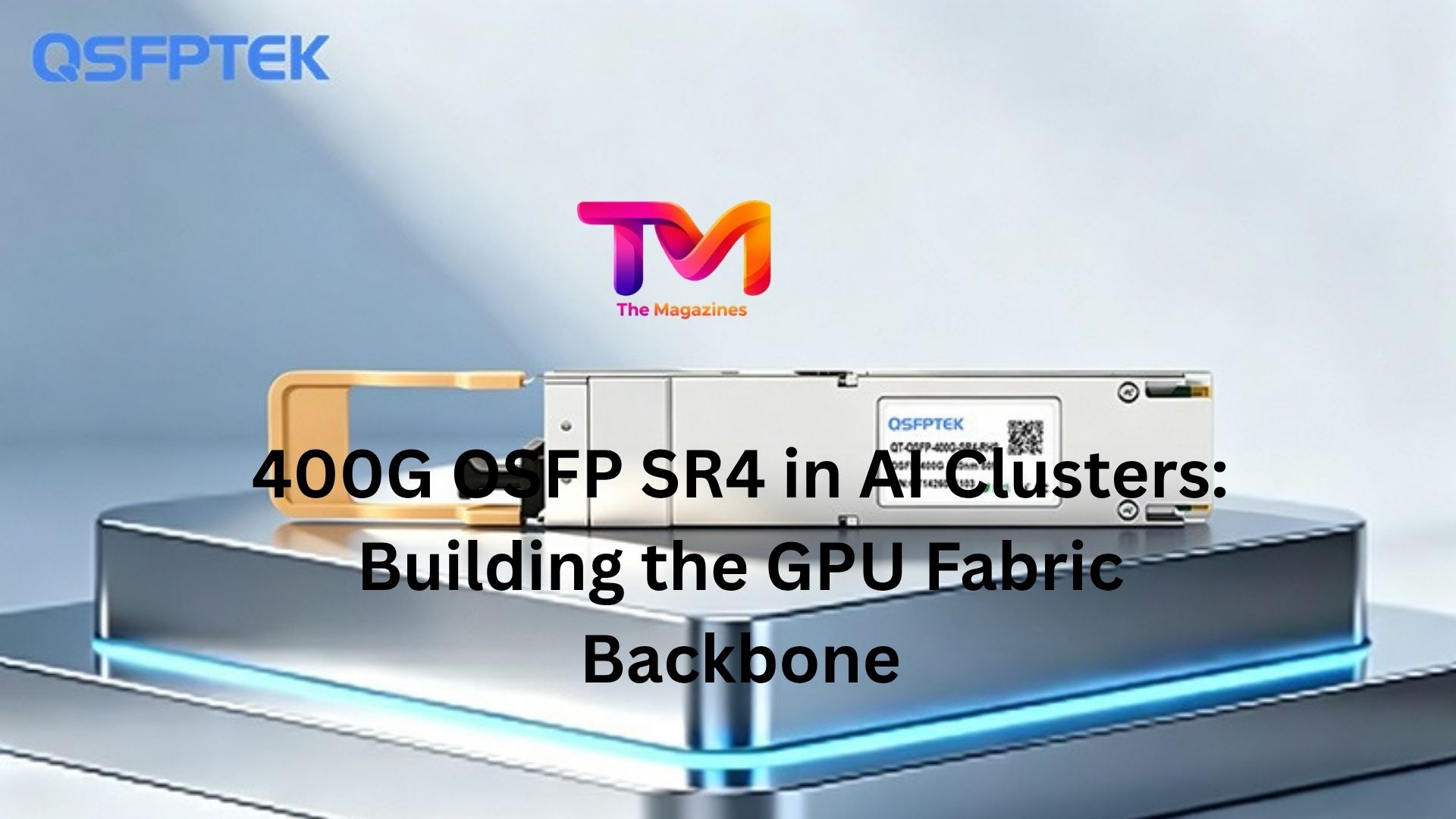
400G OSFP SR4 modules, in particular, have become widely adopted because they align well with existing multimode fiber infrastructure while delivering the bandwidth required for modern GPU clusters.
Many deployments still rely on MPO-based structured cabling, which makes SR4 a natural fit. It allows operators to scale bandwidth without completely redesigning the physical layer, at least in the short term.
OSFP Form Factor and Density Considerations
One of the key differences in 400G deployments is the move to OSFP modules. Compared to earlier QSFP-based designs, OSFP offers better thermal performance and higher power handling capability, which is critical in dense AI switches.
In practice, AI switches running 400G SR4 are often fully populated with high-speed ports, and thermal design becomes just as important as bandwidth. Airflow direction, heat dissipation, and cage design all directly affect module stability under sustained load.
This is not a “plug and forget” environment. Everything runs close to its physical limits.
MPO Infrastructure Still Defines the Real Bottleneck
While 400G SR4 delivers bandwidth at the optical level, the physical layer, especially MPO cabling, often becomes the limiting factor in real deployments.
Each link depends on precise fiber alignment across multiple lanes. A small issue like dust contamination, improper polarity, or slight connector damage can impact multiple data lanes at once. In a GPU cluster where hundreds or thousands of links are active simultaneously, this creates a non-trivial operational challenge.
That is why many operators spend as much time on cable management and testing as they do on the actual compute infrastructure.
The Role of 400G in GPU-to-GPU Communication
At a system level, 400G SR4 links form the backbone of GPU-to-GPU communication inside the cluster fabric. Whether the underlying protocol is Ethernet or InfiniBand, the goal is the same: keep GPUs fed with data as efficiently as possible.
As model sizes continue to grow, the demand for faster synchronization increases as well. Training large language models, for example, depends heavily on consistent high-bandwidth communication across nodes. Without a strong 400G fabric, compute resources sit idle waiting for data.
Conclusion
400G OSFP SR4 is not just another upgrade in line rate, it has become a foundational element in AI cluster design. It enables the dense, high-throughput GPU fabrics that modern training workloads depend on, while still leveraging existing multimode infrastructure and MPO-based cabling systems.













Leave a Reply