
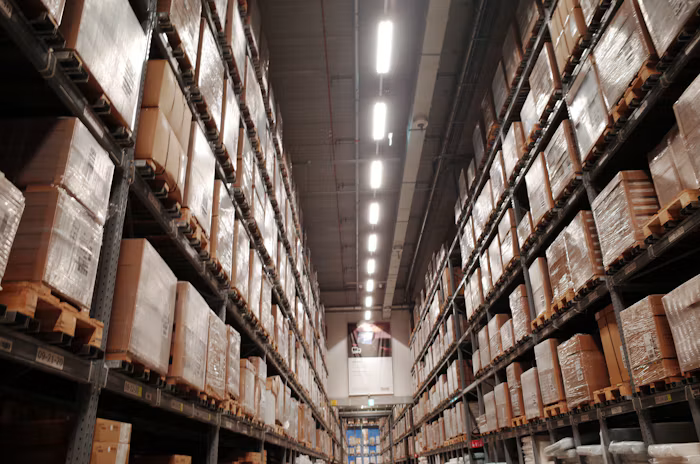
Industrial warehousing is undergoing an aggressive structural transformation. Escalating utility tariffs, stringent corporate Environmental, Social, and Governance (ESG) mandates, and 24/7 fulfillment schedules are forcing logistics operators to scrutinize building infrastructure.
Among all facility systems, industrial lighting remains one of the largest continuous consumers of electric power. In standard distribution centers, baseline illumination frequently represents 25% to 40% of total electrical energy expenditure.
Modern facility engineering now prioritizes energy efficiency not merely as an operational cost-cutting exercise, but as a core pillar of operational risk mitigation and sustainable capital deployment.
The Shift Towards Sustainable Industrial Lighting
Historically, industrial logistics hubs relied on legacy High-Intensity Discharge (HID) fixtures, primarily Metal Halide (MH) and High-Pressure Sodium (HPS) systems. While these luminaires delivered substantial initial lumen output, their systemic inefficiencies and accelerated lumen depreciation no longer align with high-throughput supply chain standards.
As modern warehouses operate around the clock, legacy lighting systems not only drain immense power reserves but also create continuous maintenance liabilities. Consequently, the industrial standard has decisively shifted toward solid-state lighting fixtures engineered with advanced thermal dissipation mechanisms and ruggedized ingress protection.
For instance, commercial-grade LED solutions from established engineering manufacturers like WOSEN demonstrate how tailored optical distributions and robust die-cast aluminum enclosures dramatically cut ongoing kilowatt-hour draw while extending service intervals under harsh operational conditions.
Transitioning to advanced solid-state architecture resolves the historical compromise between high-bay photometrics and operational sustainability. Modern systems ensure continuous high-lumen output without placing excessive thermal loads on interior warehouse spaces.
Energy Consumption Metrics
Evaluating the transition from legacy gas-discharge fixtures to solid-state systems requires an analysis of core electrical and optical metrics:
- Luminous Efficacy: High-performance industrial LED high-bay fixtures deliver between 140 and 180 lumens per watt (lm/W) at the system level. In contrast, legacy metal halide ballasts deliver an effective net efficacy of only 50 to 75 lm/W once internal heat loss and optical housing trapping are calculated.
- Effective Wattage Draw: Replacing a standard 400W metal halide luminaire (which actually pulls roughly 458W when accounting for magnetic ballast losses) with an equivalent 150W industrial LED yields an immediate, direct power load reduction of over 67%.
- Power Factor and Total Harmonic Distortion: High-grade industrial LED drivers maintain a Power Factor (PF) > 0.95 and keep Total Harmonic Distortion (THD) below 15%. This minimizes wasted apparent power (kVA) and prevents harmonic overheating in facility distribution transformers.
- Instantaneous Restrike Capability: Gas-discharge fixtures require an operational restrike and warm-up latency of 10 to 20 minutes following a line voltage drop. Modern LEDs offer instant-on/instant-off switching, eliminating the costly practice of leaving high-bay arrays illuminated during unoccupied operational downtime.
Key Factors in Designing a Modern Warehouse Lighting System
Designing an industrial lighting layout demands balancing regulatory photometrics, optical beam symmetry, and fixture durability. An optimal lighting plan minimizes glare while delivering consistent vertical and horizontal foot-candle distribution across narrow storage aisles.
Facility planners must account for ceiling clearance heights, crane travel zones, and inventory racking density to ensure consistent visibility without creating severe contrast ratios.
Foot-Candles and Lux Requirements for Workplace Safety
Workplace illumination is a core determinant of industrial occupational health and hazard reduction. Insufficient or uneven lighting creates visual blind spots, exacerbates operator eye fatigue, and significantly raises the probability of forklift collisions in high-traffic intersections.
Industrial facilities must align with safety benchmarks established by the Occupational Safety and Health Administration (OSHA 29 CFR 1910.1200 / 1926.56) and the Illuminating Engineering Society (IES RP-7-20):
- Open Bulk Storage & Active Loading Docks: Staging zones and loading docks require a baseline illuminance of 20 to 30 foot-candles (215 to 320 Lux) to facilitate safe trailer backing, pallet loading, and barcode scanning.
- Narrow-Aisle High-Density Racking: Aisle corridors require 10 to 15 vertical foot-candles (100 to 160 Lux) measured across vertical shelf faces from the floor level to the upper pallet tier. Vertical uniformity prevents dark banding along top-tier storage.
- Detailed Picking, Packing, & Sorting Stations: Precision fulfillment cells mandate 30 to 50 horizontal foot-candles (320 to 540 Lux) to lower order fulfillment errors and protect operators handling high-speed automated machinery.
- Color Rendering Index (CRI): Modern warehouse operations require a minimum CRI of 80 Ra. Superior color fidelity allows pickers to quickly distinguish color-coded labeling, safety signage, and warning striping.
Heat Dissipation and Fixture Durability
Warehouse roof decking experiences severe thermal stratification, where interior ambient temperatures near structural trusses routinely reach 45°C to 55°C (113°F to 131°F) during summer months.
Because LED diodes are semiconductor devices, excessive junction temperature represents the single greatest threat to driver longevity and lumen maintenance:
- Thermal Management Architecture: Premium industrial fixtures utilize heavy-duty die-cast aluminum alloys (such as ADC12 or 6063 extruded aluminum). Engineered radial heatsinks facilitate passive natural convection, holding junction temperatures below critical degradation thresholds.
- Ingress Protection (IP Ratings): Distribution hubs generate considerable airborne dust, carton particulates, and ambient humidity. Fixtures must feature IP65 or IP66 environmental sealing to completely isolate electronic drivers and optical arrays from moisture ingress and particulate buildup.
- Mechanical Impact Resistance: Fixtures installed along equipment transit routes must achieve an IK08 to IK10 mechanical impact rating, ensuring internal optics withstand accidental contact from elevated forklift masts or material handling equipment.
Calculating the True ROI of LED Upgrades
Financial approvals for industrial lighting retrofits depend on capital expenditure (CapEx) justification through demonstrable operational expense (OpEx) reductions.
Comprehensive financial modeling must evaluate not only raw kilowatt-hour savings, but also the total avoidance of mechanical maintenance overhead over a multi-year horizon.
Immediate Energy Savings vs. Long-Term Value
Evaluating capital investments solely on utility reductions underestimates the true economic return of solid-state industrial luminaires:
- Direct Utility Savings: Continuous 24/7/365 facility operation equates to 8,760 operational burn hours annually. Converting 500 legacy 400W fixtures to 150W LED luminaires removes approximately 1,349,040 kWh from annual facility consumption, yielding tens of thousands of dollars in direct baseline savings.
- Elimination of Elevated Maintenance Overhead: Relamping high-bay fixtures requires renting specialized equipment, such as electric scissor lifts or articulating boom lifts, costing $500 to $1,200 per day, alongside certified high-voltage electricians.
- Downtime Mitigation: Servicing burnt-out ballasts in active facilities requires closing off racking aisles and rerouting material handling traffic. LEDs effectively eliminate the operational bottlenecks and inventory delays caused by routine lighting maintenance.
- L70/B50 Useful Operating Life: Industrial-grade LED arrays carry certified L70/B50 ratings exceeding 50,000 to 100,000 operating hours. This represents over a decade of continuous performance without relamping, compared to legacy metal halides that suffer 30% to 50% lumen depreciation within their first 8,000 hours.
- Payback Horizon: Taking into account regional utility energy efficiency rebates, equipment rental avoidance, and reduced HVAC heat load, most industrial facilities achieve full capital payback within 12 to 24 months.
Integrating Smart Controls and Future Trends
The convergence of industrial Internet of Things (IoT) infrastructure with solid-state lighting transforms static warehouse fixtures into intelligent, responsive assets.
Modern facility architects integrate networked sensors directly into the luminaire chassis, transitioning facilities from scheduled illumination to dynamic, demand-based lighting.
Motion Sensors and Daylight Harvesting
Integrating automated, intelligent control strategies suppresses energy consumption baselines to the absolute theoretical minimum:
- Passive Infrared (PIR) and Microwave Occupancy Sensors: High-bay sensors adjust lighting intensity based on real-time activity. Fixtures in unoccupied aisles drop to a 10% to 20% standby background level, instantly restoring to full 100% operational brightness the moment a forklift enters an aisle.
- Continuous Daylight Harvesting: Facilities equipped with skylights, clerestory windows, or translucent roof panels use integrated photocell sensors. These sensors dynamically modulate artificial light output down in response to incoming natural sunlight, reducing perimeter electrical draw by an additional 30% to 60% during peak daylight hours.
- DALI-2 and 0-10V Architectural Dimming: Utilizing digital communication protocols enables smooth, flicker-free lumen modulation without shortening driver life or degrading diode spectral quality.
The strategic transition to intelligent, energy-efficient lighting provides a practical foundation for enterprise logistics hubs targeting aggressive net-zero and carbon-reduction milestones.
Rigorous scientific assessments confirm that the widespread adoption of LED technology has the validated technical potential to reduce national lighting electrical demand by nearly 50% across industrial and commercial infrastructures, solidifying solid-state luminaires as an indispensable asset for enterprise ESG roadmaps.
Conclusion
Upgrading industrial warehouse lighting is far more than a routine facilities maintenance task; it is an executive-level strategic investment.
By replacing inefficient legacy gas-discharge fixtures with ruggedized, optically precise industrial LEDs, facility operators secure immediate, double-digit reductions in utility overhead, eliminate costly high-bay maintenance cycles, and elevate workplace safety compliance.
As the global logistics sector moves toward smart automation and rigorous sustainability benchmarks, robust solid-state lighting establishes the operational baseline required for resilient, future-ready warehouse facilities.





Leave a Reply