
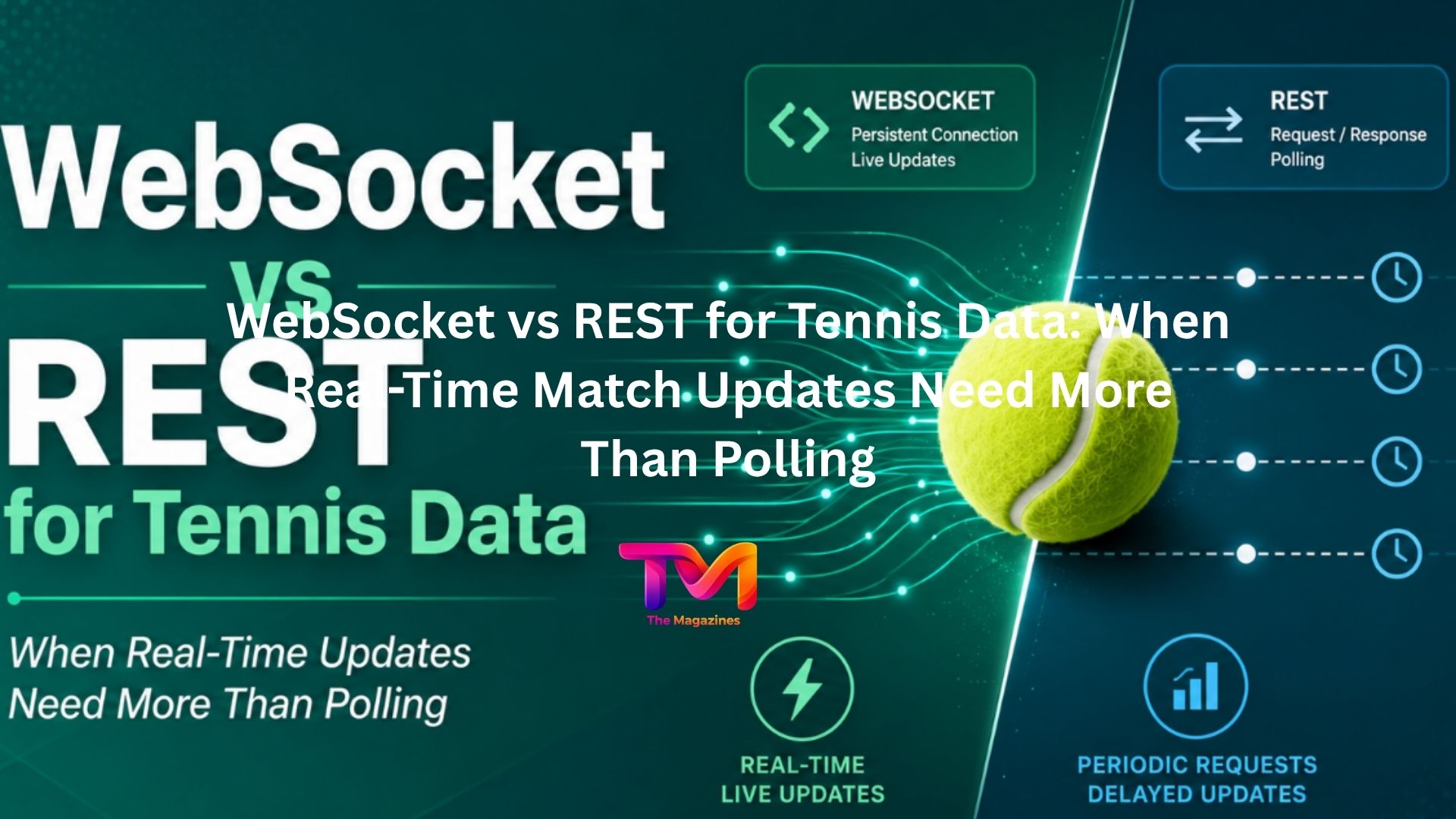
A practical guide for developers deciding when REST is enough, when WebSocket-style updates become valuable, and why many production tennis apps need both.
Introduction
Most tennis data integrations start with REST because it is familiar, easy to test and simple to connect to a backend or frontend. The app requests fixtures, rankings, player profiles or results, and the API returns structured data.
The question becomes more complicated when the product needs to feel live. Polling every few seconds may be acceptable for small products, but real-time match centres, live scoreboards and alert systems often need a smarter approach.
Before choosing an update model, developers should review Tennis API documentation and consider how live endpoints such as the Tennis Live API on RapidAPI will behave under real user traffic.
Key Takeaway
REST and WebSocket-style updates solve different problems. REST is excellent for structured lookup and scheduled refreshes, while event-driven updates are valuable when active matches need to feel genuinely live.
REST Is Still the Right Tool for Many Features
REST should not be dismissed just because a product includes live data. It is predictable, easy to cache and easy to debug. For many tennis features, REST is the cleanest solution.
Fixtures, completed results, rankings, player profiles, tournament metadata and historical records do not usually need second-by-second delivery. They need reliable structure, sensible caching and clear response fields.
- Fixtures
- Schedules
- Completed results
- Player profiles
- Ranking tables
- Tournament metadata
- Historical match records
Where Polling Starts to Struggle
Polling means repeatedly asking whether anything changed. It is easy to implement, but it can become inefficient or stale depending on interval choice. A slow interval makes scores feel delayed. A fast interval increases request volume.
The problem grows when several matches are live at once. Polling every active match with the same frequency can waste resources, especially if some matches are in changeovers, suspended or nearly complete.
What WebSocket-Style Updates Add
WebSocket-style delivery changes the relationship between client and server. Instead of constantly asking whether data changed, the application can receive updates when relevant events happen.
This can make active match pages feel more responsive. Score changes, set completions, suspensions and match finishes can update the interface quickly without the same polling overhead.
- Live scoreboards
- Real-time match centres
- Push alert systems
- Tournament operations dashboards
- Sports media live coverage
The Best Architecture Is Often Hybrid
Many production products should not choose only REST or only WebSocket. A hybrid model is often better. REST loads baseline data such as fixtures, players and tournament context. WebSocket-style updates then handle active match changes.
REST can also act as the recovery layer. If a live connection drops, the app can fetch the current match state, resync and continue. This prevents missed events from corrupting the interface.
| Use Case | Better Fit | Reason |
| Player profile | REST | Changes less frequently and is easy to cache. |
| Live match score | WebSocket-style updates | Users expect fast state changes. |
| Completed results archive | REST | Stable data after confirmation. |
| Reconnect recovery | REST | Fetches current truth after missed events. |
AI and Search Still Need REST-Like Retrieval
Even if a product uses live event delivery, AI and smart search usually need structured retrieval. A user asking for a player’s recent matches or a tournament’s completed results needs a queryable data layer.
That is another reason hybrid architecture works well. Live updates serve the moment, while structured retrieval powers profiles, archives, search and AI summaries.
Common Mistakes to Avoid
The most common mistake is building for a clean demo instead of real tennis. Demos usually show scheduled matches, live scores and normal completed results. Production needs to handle delays, suspensions, retirements, walkovers, tiebreaks, duplicate-looking names and changing tournament context.
Another mistake is treating data fields as isolated. Player IDs, match IDs, tournament IDs, round values, surfaces, rankings and status fields should work together. If they do not, every future feature becomes harder to maintain.
- Using player names instead of stable IDs.
- Ignoring match status and result type.
- Failing to connect fixtures to live scores and final results.
- Adding AI summaries before the data layer is trustworthy.
- Caching all tennis data with the same refresh rules.
Expert Perspective
“REST and real-time delivery are not enemies. The strongest tennis integrations use each approach where it fits the product experience and recovery model.”
— James Morris, Founder
Implementation Detail That Matters
One practical way to improve reliability is to design the database around the lifecycle of a match. A fixture should not be treated as a temporary object that disappears when play begins. It should become the live match, then the completed result, while retaining the same identity and relationships.
This approach helps frontend teams, backend services and content workflows use the same source of truth. The player page, tournament page, live scoreboard, archive and AI summary should all point back to the same underlying records rather than separate copies of similar data.
It also makes testing easier. Developers can test scheduled, live, suspended, retired, walkover and completed states against one consistent model. That is much safer than building one-off handling for each page template.
Implementation Detail That Matters
One practical way to improve reliability is to design the database around the lifecycle of a match. A fixture should not be treated as a temporary object that disappears when play begins. It should become the live match, then the completed result, while retaining the same identity and relationships.
This approach helps frontend teams, backend services and content workflows use the same source of truth. The player page, tournament page, live scoreboard, archive and AI summary should all point back to the same underlying records rather than separate copies of similar data.
It also makes testing easier. Developers can test scheduled, live, suspended, retired, walkover and completed states against one consistent model. That is much safer than building one-off handling for each page template.
Final Verdict
WebSocket vs REST for Tennis Data: When Real-Time Match Updates Need More Than Polling is ultimately about product trust. A tennis site or app can look polished while still breaking when match states change, rankings move, fixtures shift, or historical records need context.
The strongest implementations start with structure. They connect players, matches, tournaments, rankings, scores, stats and results through stable IDs and clear status fields. That gives developers a foundation for live pages, archives, search, analytics and AI-assisted product features.
For teams building serious tennis products, the priority is not just getting data onto a page. It is making the data reliable enough that users, editors, developers and automated systems can depend on it every day.















Leave a Reply